If you’ve ever looked at the massive leg press machine and wondered, “What muscles does the leg press work?”, you’re not alone. This powerhouse piece of equipment is a cornerstone of lower-body training for building raw strength and impressive muscle size. This guide provides a definitive, science-backed breakdown of every muscle involved, from the primary movers to the crucial stabilizers. We will answer that core question in detail: the leg press is a compound movement that primarily targets the muscles of the lower body, but its effects ripple through the core. We’ll also tackle specific queries about abs, thigh size, and machine variations to give you the complete picture.
The Primary Movers: The Powerhouse Muscles (The “Workhorses”)
The biomechanics of the leg press are straightforward. The movement involves simultaneous knee extension and hip extension. The primary movers are the muscle groups responsible for these actions. These are the workhorses that drive the weight.
Quadriceps (Quads)
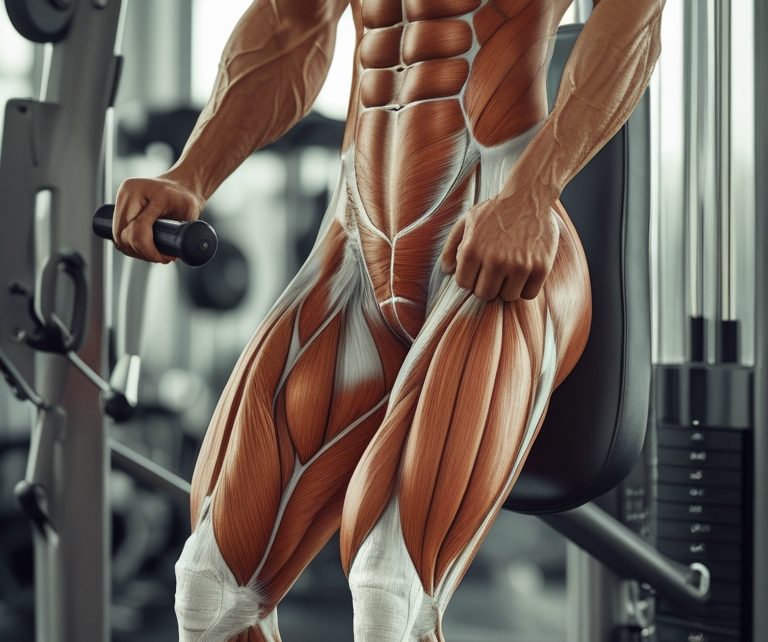
Your quadriceps, or quads, are the group of four muscles on the front of your thigh. They are the rectus femoris, vastus lateralis, vastus medialis, and vastus intermedius. Their primary role is knee extension—straightening your leg. In the leg press, they are the dominant muscle group. As you push the platform away, your quads contract powerfully to extend your knees against the resistance.
Electromyography (EMG) studies, which measure muscle activation, consistently show very high quadriceps activity during the leg press. Fitness authorities like the National Academy of Sports Medicine (NASM) classify it as a “knee-dominant” exercise for this reason. If your goal is to build strong, developed thighs, the quads get the lion’s share of the work.
Glutes (Gluteus Maximus)
The gluteus maximus is your largest hip muscle. Its involvement in the leg press is highly dependent on your form, specifically your range of motion and torso angle. When you lower the weight deeply—bringing your knees toward your chest—you increase hip flexion. This deeper position then demands more glute engagement to initiate the upward press. A shallow press minimizes glute work. So, to answer a related question, what muscles do the horizontal leg press work? The same primary movers, but emphasis can shift, as we’ll explore later.
Biomechanics studies confirm that glute activation increases significantly with greater depth and hip flexion.
The Supporting Cast: Secondary Muscles & Stabilizers
Beyond the major players, a team of secondary muscles and stabilizers springs into action. They don’t provide the main pushing power, but they are essential for control, safety, and force transfer.
Calves (Gastrocnemius & Soleus)
Your calves, located on the back of your lower leg, are responsible for plantarflexion (pointing your toes). In the leg press, they act as synergists. They engage during the pushing phase to provide a stable, solid platform for your foot. This is especially true during the final part of the leg extension. The soleus muscle, which lies beneath the gastrocnemius, is particularly active in this stabilizing role.
Core Engagement in Leg Press
This is a critical and often misunderstood component. The “core” here means not just your abs, but your entire trunk stabilizer complex. This includes the transverse abdominis (your body’s natural weight belt), obliques, and rectus abdominis (the “six-pack” muscle).
Their role is critical isometric stabilization. They do not dynamically move your spine. Instead, they brace and contract statically to:
- Maintain a neutral spine pressed firmly into the seat pad.
- Prevent your pelvis from tucking under (“butt wink”) or your lower back from rounding at the bottom of a deep press.
- Create intra-abdominal pressure to stabilize your spine under heavy load. This stiffness allows the force generated by your legs to transfer efficiently to the platform without energy leakage or injury risk.
This principle is known as “proximal stiffness for distal mobility.” A stable core (proximal) allows for powerful leg movement (distal). It’s a concept supported by spine biomechanists and strength authorities like the National Strength and Conditioning Association (NSCA).
Source for principle: https://www.nsca.com/education/articles/
Direct Answer: Does Leg Press Work Abs?
This is a very common question, and the answer is nuanced: Yes, but not in the way most people hope.
- How it works abs: The leg press requires strong isometric core bracing for stabilization, exactly as described above. This strengthens your core’s ability to stabilize and protect your spine under load, which is a fundamental type of strength.
- How it doesn’t work abs: It is not a dynamic abdominal exercise. There is no spinal flexion, rotation, or significant anti-lateral flexion challenge. Therefore, it provides minimal stimulus for building abdominal hypertrophy (muscle size) or increasing strength in movements like crunches.
Conclusion: The leg press is excellent for building core stability but is inefficient for building visible “six-pack” muscles compared to targeted movements. EMG studies show that while core muscles are active during leg press, activation levels in the rectus abdominis are far higher during dedicated exercises like planks or crunches.
Direct Answer: Does Leg Press Increase Thigh Size?
Yes. The leg press is a highly effective exercise for increasing the size of the quadriceps, which form the front of the thigh.
Here’s why:
- The quads are the primary mover, so they receive the greatest mechanical tension—a key driver of growth.
- Muscle growth (hypertrophy) requires training with sufficient volume, load, and effort. The leg press allows you to safely use very heavy loads and control time-under-tension, creating an ideal environment for quad growth.
- It contributes less to hamstring size growth compared to dedicated hip-extension exercises like deadlifts or leg curls.
- The bigger picture: Actual thigh size increase also depends on your overall training program, nutrition (being in a caloric and protein surplus), and genetics.
The work of hypertrophy expert Brad Schoenfeld, Ph.D., on the drivers of muscle growth aligns perfectly with the leg press’s capabilities for the quads.
Source: https://www.lookgreatnaked.com/blog/
Direct Answer & Comparison: What Muscles Do The Horizontal Leg Press Work?
Let’s clarify the difference between machine designs. The core principle is this: The same primary and secondary muscle groups are targeted. The difference lies in biomechanical emphasis.
Angled (45-Degree) Leg Press
- Your body is in a reclined position.
- This design often allows for a greater range of motion and deeper knee flexion.
- The increased depth and hip flexion can lead to greater stretch and activation of the glutes at the bottom of the movement.
Horizontal (Seated/Sled) Leg Press
- Your body is more upright, with your torso closer to 90 degrees.
- This may limit your depth to maintain full spine contact with the back pad.
- The “pushing straight out” vector can make the movement feel more isolated on the quadriceps for some users.
Reiterating the constant: Regardless of the machine angle, core engagement for stabilization remains a non-negotiable requirement. Comparative biomechanics studies show how changes in torso inclination alter joint angles and muscle emphasis. Analysis from coaches like Bret Contreras also notes the relationship between hip flexion and glute activation.
Source: https://bretcontreras.com/
Practical Application: How to Target Muscles Effectively & Safely
Knowing the muscles is one thing. Targeting them effectively is another. Here’s how to tailor your leg press routine.
Foot Placement Variations
- High on the Platform: Places more emphasis on the glutes and hamstrings by increasing the degree of hip flexion and extension.
- Low on the Platform: Emphasizes the quadriceps by increasing the demand on knee flexion and extension.
- Wide Stance: Can increase involvement of the adductors (inner thigh) and engage the gluteus medius for hip stability.
- Narrow Stance: Focuses stress more directly on the quad muscles.
Form Cues for Maximum Benefit & Safety
- Brace Your Core: Before you move, take a breath into your belly and brace your abs as if preparing for a punch. Maintain this stiffness throughout the rep.
- Control the Descent: Lower the weight with control. Avoid bouncing at the bottom, which can compromise your spine and joints.
- Mind the Top: Press to a position where your legs are extended but not violently locked out. Keep a slight, soft bend in the knees.
- Spine Position: Keep your lower back and pelvis neutral and in full contact with the pad. Never let your lower back round or lift off the pad.
Programming Context
The leg press is versatile. Use it as a primary lift in a hypertrophy-focused lower body day, or as a secondary movement for added volume. For example, perform barbell squats first for overall strength, then use the leg press for targeted quad volume with higher reps.
Conclusion: Synthesizing the Complete Answer
So, what muscles does the leg press work? The complete answer: it is a quad-dominant compound exercise that also significantly involves the hamstrings and glutes. Essential support comes from the calves and, crucially, a stabilizing core complex.
To recap our direct answers:
- It effectively builds thigh size, primarily in the quadriceps.
- It works the abs for stability and spinal protection, not for dynamic development or aesthetics.
- Horizontal and angled presses work the same muscle groups, with subtle shifts in emphasis toward the quads or glutes based on mechanics and depth.
When performed with intention, proper form, and full range of motion, the leg press remains an invaluable tool for comprehensive lower-body development.