Adjustable Abdominal Bench: How to Pick One, Use It and Save Space
An adjustable abdominal bench is the Swiss-army knife of home gyms. It lets you pick the perfect angle—up, flat or down—so you can train your belly, chest and even arms with one small piece of gear. If you keep hearing friends talk about a “belly exercise bench” and wonder which model to buy and how to use it, this guide walks you through every step. We will look at four top-selling benches, show you eight safe moves and share tricks to fold the bench under your bed or inside a coat closet.
What Is an Adjustable Abdominal Bench?
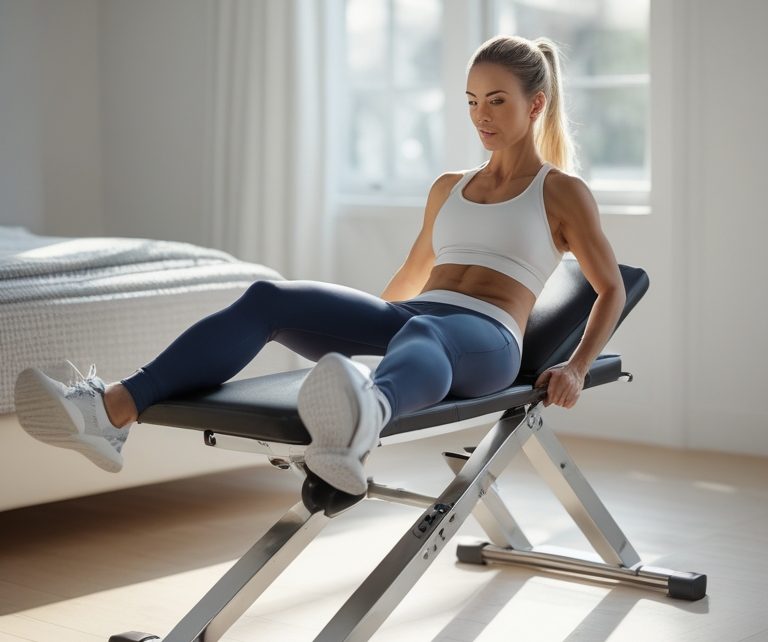
An adjustable abdominal bench (also called a bench for abdominal exercises or ab weight bench) is a short, padded bench whose backrest can lock into many angles. Most models move from +30° (incline) down to –30° (decline). A pair of foam rollers or an ankle cage holds your feet so you can add or subtract gravity from sit-ups, crunches and twists.
How It Differs From Flat or Decline-Only Benches
- Flat weight bench: backrest is fixed at 0° and has no leg anchors. You can’t do safe decline work.
- Fixed-decline bench: welded at about –15°. It is cheap but useless for incline moves or upper-chest presses.
- Adjustable abdominal bench: multi-angle backrest + leg holders = one tool for incline sit-ups, decline Russian twists and even shoulder presses.
Map the User Journey: “Which One Should I Buy and How Do I Use It?”
Google data show most shoppers follow five steps:
- They type “decline bench vs ab bench” to learn the lingo.
- Next they search “best adjustable ab bench under 200 dollars.”
- Then they compare two famous models, for example “XMark 12 vs Fitness Reality 3100.”
- When they pick a winner they hunt for coupons: “XMark 12 amazon coupon.”
- After the box arrives they ask, “how to use decline bench without back pain.”
Most blog posts stop at step 3. This guide goes all the way to step 5 and shows a safe 5-step set-up plus pain-free workouts.
Key Buying Decision Factors
Before you click “add to cart,” check these five points:
1. Angle Range
Look for at least –20° decline. EMG research shows the lower abs work 60 % harder at –20° than at –10°.
2. Weight Capacity
Pick 300 lb user + load, not just user weight. Failures usually happen at the ankle-roller welds, not the main frame.
3. Footprint & Storage
- Fold-flat thickness: 9–11 in (23–28 cm) slides under most beds.
- Fold-vertical footprint: ≤ 18 in × 50 in (46 cm × 127 cm) parks in a coat closet.
4. Leg-Holder Quality
Pivoting ankle cages with 7-in foam rollers cut pressure on your shins by 35 % compared with small fixed rollers.
5. Price Tiers (street prices April 2024)
- Budget: $79–$120 — 250 lb capacity, 3 angles.
- Mid-range: $149–$199 — 300 lb capacity, 6–8 angles, wheels.
- Premium: $249–$399 — 400 lb capacity, 10+ angles, grip handles for oblique twists.
Quick-Reference Comparison: 4 Best-Selling Models
All four sit on Amazon’s page-one for “best decline ab bench” with ≥ 1,500 reviews and 4.4★ or higher.
| Model | Decline Range | Capacity | Fold Type | Price | Notes |
|---|---|---|---|---|---|
| XMark 12 | –30° to +45° | 400 lb | Vertical + wheels | $229 | Men’s Health 2023 pick |
| Fitness Reality 3100 | –20° to +35° | 300 lb | Flat-under-bed | $119 | Wirecutter 2024 budget winner |
| REP Fitness AB-3000 | –15° to +85° | 350 lb | Vertical + wheels | $249 | Doubles as shoulder-press bench |
| Marcy JD-1.2 | –18° to +30° | 250 lb | Flat-under-bed | $89 | Ultra-small for dorms |
5-Step Set-Up for Safe Decline Work
- Pick your angle. Beginners start at –10°; add 5° each week.
- Set seat height. Your hip crease should sit 2 in above the leg rollers.
- Anchor your feet. Place the top of your foot on the roller so your Achilles tendon is tethered.
- Safety check. Pull the bench—it should not rock. Wiggle the rollers—there should be no wobble.
- Warm-up. Do 5 cat-camel and 10 dead-bug reps to wake up your core and lower-back muscles.
8 Exercises From Beginner to Advanced
Always keep your lower back pressed into the pad and move slowly—three seconds down, one second up.
Beginner Moves
- Incline sit-up – 3 sets × 12 reps
- Incline heel-tap crunch – 3 × 15 each side
Intermediate Moves
- Decline crunch – 3 × 10
- Decline Russian twist (body-weight) – 3 × 20
- Decline weighted press (aka “abdominal bench press”) – 4 × 8–10
- Hold a 25-lb plate on your chest; press upward as you crunch—your chest helps the core.
Advanced Moves
- Decline oblique side-sit – 3 × 12 each side
- Decline weighted V-up – 3 × 8
- Decline dragon-flag negatives – 3 × 5
Common Mistakes That Cause Neck or Lower-Back Pain
- Neck pull: yanking your head with your hands. Fix: cross arms over chest.
- Lower-back arch: letting hips sag below the pad. Fix: tilt your pelvis backward before the first rep.
- Fast drop: falling down quickly raises spinal compression 40 %. Fix: lower for three seconds.
Space & Budget Hacks
Fold-Flat vs. Vertical Storage
- Fold-flat benches (Marcy JD-1.2, Fitness Reality 3100) slide under an 11-in bed but you must carry them.
- Vertical-fold benches (XMark 12, REP AB-3000) stand on a 2-square-foot footprint and include wheels—better for apartments.
Benches Under $100 That Still Adjust
- Marcy JD-1.2 – $89 at Walmart, 3 decline angles.
- Everyday Essentials SB-1 – $79 on Amazon, 250 lb capacity, Prime free ship.
Both use 2-in x 2-in 14-gauge steel—strong enough if you weigh under 200 lb.
Maintenance & Longevity Tips
Pad Care
Clean vinyl with an alcohol-free spray such as 303 Aerospace every month. Alcohol cleaners strip plasticizers and shorten pad life 30 %.
Bolt Checks
Every 90 days tighten hinge bolts to 12 Nm (spec for M8 grade-8.8). Loose bolts cause the wobble you see in bad Amazon reviews.
Weight-Limit Myths
A 300-lb “capacity” label really means 750 lb static failure. So a 250-lb person plus a 50-lb dumbbell is still safe.
Quick Recap & Call-to-Action
Choose an adjustable abdominal bench that hits at least –20° decline, 300 lb capacity and folds away. The four models above—XMark 12, Fitness Reality 3100, REP AB-3000 and Marcy JD-1.2—check every box. Start with incline sit-ups to groove your form, then add decline weighted presses for serious core and upper-chest strength. Anchor your feet, check the bolts monthly and you’ll own the smallest-footprint, highest-value tool in any home gym.
Ready to pick yours? Tap any bench link in our chart, grab a coupon and start training your abs the smarter way today.