Activate Your Glutes While Climbing Stairs: The Definitive Guide to Building Strength Step by Step
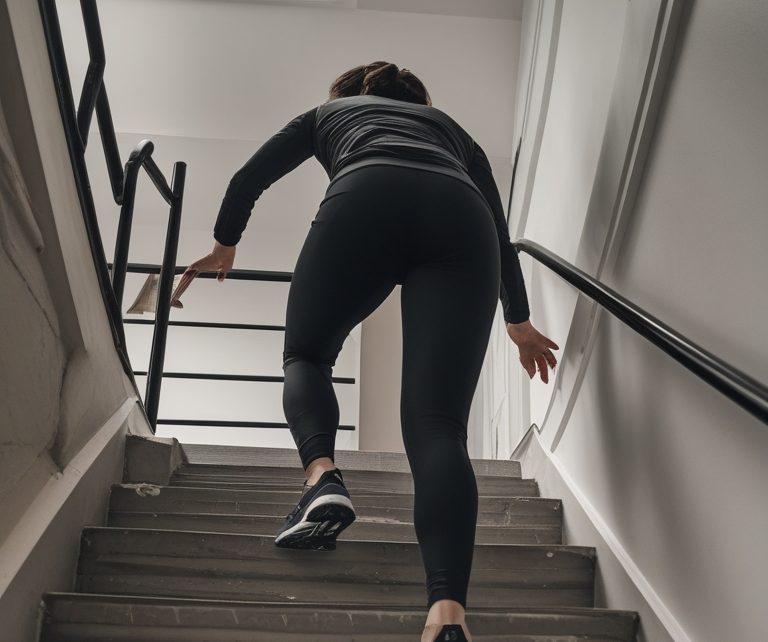
You climb flights of stairs every day. At home, at work, in parking garages. But you only feel it in your legs or you just get out of breath. You never feel the burn in your glutes.
This is incredibly common. But it means you’re missing a major strength-building opportunity.
The truth is, learning to activate your glutes while climbing stairs is a deliberate, learnable skill. It transforms a daily activity into targeted, powerful strength training. The problem often stems from “gluteal amnesia,” where your nervous system under-recruits your glutes, leading your quads and lower back to take over. (Source: NASM – The Science of Corrective Exercise).
Mastering this technique unlocks stronger, more powerful glutes, improved posture, better athletic performance, and a reduced risk of knee and back pain.
This definitive guide will teach you the exact, research-backed technique to master stair climbing glute activation. Let’s get started.
Why Your Glutes Are Crucial (And Why Stairs Are Perfect)
Your gluteal muscles are your body’s powerhouse. They are not just for looks. They are essential for movement, stability, and injury prevention.
The glute group has three main muscles:
- Gluteus Maximus: The largest. It provides power for hip extension (pushing your thigh backward).
- Gluteus Medius: On the side of your hip. It keeps your pelvis stable when you walk or stand on one leg.
- Gluteus Minimus: Under the medius. It helps with hip stability.
Their primary job is hip extension. This is the exact movement of pushing your body up onto the next step when you are stair climbing.
When these muscles are weak or inactive, other body parts suffer. You get muscle imbalances from over-using your quadriceps and hamstrings. Your knee joints and lumbar spine (lower back) take on extra strain as they try to compensate. A review in the Journal of Orthopaedic & Sports Physical Therapy directly links gluteus medius weakness to lower extremity injuries. (Source: JOSPT – The Role of the Gluteus Medius).
This is where stair climbing becomes the ideal, accessible solution. It’s a natural, loaded hip extension exercise. Research shows that focused glute activation during these movements improves hip extension kinetics, meaning you move more powerfully and safely. (Source: JSCR – Gluteal Activation on Hip Extension). Every staircase is a ready-made gym for your stair climbing glutes.
The Foundational Technique: How to Activate Glutes Climbing Stairs
To truly build strength, you must move with intention. Here is the step-by-step method for proper stair glute activation.
Step 1: The Starting Stance (Posture is Everything)
Stand tall at the bottom of the stairs. Chest up, shoulders back but relaxed. Gently engage your core as if bracing for a light tap. A neutral spine is non-negotiable for proper hip function.
Step 2: The Mind-Muscle Connection (The Mental Key)
Before you move, consciously think about the glute on your stepping leg. Your intent is to “squeeze” or “clench” that cheek to power the movement. This mental focus isn’t just hype. A study in the European Journal of Sport Science proved that focused intent significantly increases glute muscle activity. (Source: EJSS – Mind-Muscle Connection).
Step 3: The Execution (The Biomechanics)
- Place your entire foot on the step. Make sure your heel is down.
- Drive through your HEEL (not the ball of your foot) as you push your body upward. This shifts the work to the posterior chain (glutes, hamstrings).
- Focus on pushing the hip of your working leg forward and upward as you fully extend that leg. Visualize “leading with your hip,” not leaning your chest forward.
- At the top of the movement, with your leg straight, consciously squeeze your glute hard. This is the peak contraction.
This upright torso and hip-extension focus is supported by the biomechanics of the task. (Source: Physiopedia – Biomechanics of Stair Climbing).
Step 4: Repeat and Switch
Control the movement. Don’t rush. Maintain that crucial mind-muscle connection with every single step. This is how you learn to reliably activate glutes climbing stairs.
Common Mistakes That Kill Glute Activation (And How to Fix Them)
Even with good intentions, small errors can stop your stair glute activation completely. Here are the big ones.
Mistake 1: Leaning Forward from the Ankles
Why it’s bad: This anterior trunk inclination turns the movement into a quad-dominant knee extension. It increases lumbar spine stress and mechanically disengages the glutes.
Correction Cue: “Keep your chest up and lead with your hips.” Imagine a string pulling the crown of your head upward. Gait analysis shows trunk lean significantly alters joint loading. (Source: ScienceDirect – Trunk Inclination Effects).
Mistake 2: Pushing Primarily from the Toes/Ball of the Foot
Why it’s bad: This engages the calf and quad more, bypassing the heel-to-glute connection. You lose the power of hip extension.
Correction Cue: “Feel your weight in your heel throughout the push.” Practice on a flat surface first to get the sensation before taking it to the stairs.
Mistake 3: Using Shallow, Rushed Steps
Why it’s bad: Reduces the range of motion at the hip. Your glutes never get fully stretched or contracted, so they don’t get stimulated.
Correction Cue: “Take full, deliberate steps.” Ensure your knee is well bent at the start to properly load the glute muscle.
Level Up: Advanced Techniques for Greater Stimulus
Once you’ve mastered the basic form, use these variations to challenge your stair climbing glutes even more. This applies the training principle of progressive overload.
Technique 1: Double Steps (Increased Range of Motion)
Take two steps at once. This dramatically increases hip flexion at the start, placing the gluteus maximus in a stretched position. This leads to a more powerful contraction and builds strength through a greater range.
Technique 2: Slow Eccentrics (Focus on the Lowering Phase)
Take 3-4 seconds to slowly lower yourself back down to the starting position. This eccentric (lowering) phase is highly effective for building strength and muscle. It increases time-under-tension.
Technique 3: Isometric Hold at Peak Contraction
At the top of a step, with your leg fully extended, squeeze and hold the glute contraction hard for 2-3 seconds before proceeding to the next step. This builds muscular endurance and mind-muscle control.
These methods are backed by fundamental strength training principles outlined by the National Strength and Conditioning Association. (Source: NSCA – Essentials of Program Design).
Prime Your Muscles: Essential Pre-Stair Activation Warm-Up
A quick, targeted warm-up “wakes up” the neuromuscular connection. This makes it far easier to activate glutes while climbing stairs from your very first step.
Do 1-2 sets of 10-15 reps of each exercise before your focused stair session.
Glute Bridges
Lie on your back with knees bent. Drive through your heels to lift your hips, squeezing your glutes at the top. This teaches the basic hip extension pattern without weight.
Banded Lateral Walks
Place a resistance band just above your knees. Get in a slight squat stance. Step sideways while maintaining tension on the band. This directly activates the gluteus medius for the stability you need on stairs.
Research from the American Council on Exercise indicates that such activation drills can enhance glute recruitment in subsequent compound movements. (Source: ACE – Do Glute Activation Exercises Work?).
Making It a Habit: Integration into Daily Life
The goal is to turn this conscious practice into an unconscious, powerful habit. This is neuromuscular re-education for your stair climbing glutes.
- Start Small: Begin with just one flight of stairs per day where you focus 100% on perfect technique. Quality over quantity. https://yourfitnessradar.com/how-long-should-i-stairmaster-for-glutes/
- Habit Stack: Apply the technique every time you encounter the first flight at work, home, or the subway. Link it to an existing routine.
- Track Progress: Notice when it becomes easier. Feel for that automatic muscle engagement. Celebrate when you no longer have to think about “heel drive” because your body just does it.
Consistency is what transforms knowledge into strength.
Conclusion & Key Takeaways
You now have the complete blueprint to transform every staircase into a tool for building functional strength. Let’s recap the four pillars of effective stair glute activation:
- Posture: Chest up, core braced, neutral spine.
- Mind-Muscle Connection: Think “squeeze” before you move.
- Heel Drive: Push through your heel to engage the posterior chain.
- Full Hip Extension: Lead with the hip and squeeze at the top of the movement.
By mastering how to activate your glutes while climbing stairs, you build more powerful glutes, improve stability, and take proactive steps to prevent injury. Your next step is your first rep. Start your next climb with intention, and feel the power of your glutes driving you upward. https://yourfitnessradar.com/stairmaster-vs-treadmill-for-glutes/