That’s the wrong question to ask. The right question is: which exercise is better for YOUR specific goals?
This guide will cut through the myths. We will give you a detailed, evidence-based comparison. We’ll look at muscle engagement, glute activation, safety, strength, and real-world results. By the end, you’ll know exactly which lower body movement belongs in your program—and why.
Movement Mechanics Decoded: Understanding the Foundation
To compare these exercises, you must first understand how they work. The core difference is in the squat vs leg press muscle engagement and the movement pattern. One is a fundamental human motion. The other is a powerful machine.
The Squat: The Full-Body Powerhouse
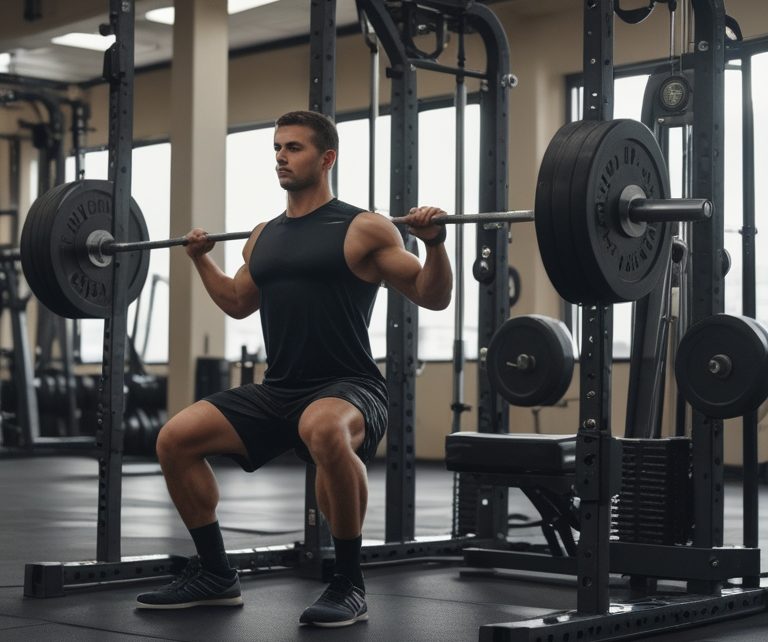
The squat is a free-weight, compound exercise. It is a basic human movement pattern, like sitting down and standing up. It uses multiple joints at once.
It is a kinetic chain movement. Force starts from the ground up. It needs coordinated effort from your ankles, knees, hips, and spine.
Muscles Worked:
- Primary Movers: Quadriceps (front of thighs), Gluteus Maximus (butt), Adductor Magnus (inner thigh).
- Critical Stabilizers: Your entire core (abs and lower back), hip stabilizers, upper back, and shoulders. They work hard to keep you balanced under the barbell.
The squat is not just a leg exercise. It is a full-body challenge. Research from the Journal of Strength and Conditioning Research confirms this. It found that back squats produce much higher activation of the stabilizing back and core muscles compared to machine exercises. https://pubmed.ncbi.nlm.nih.gov/19620925/
The Leg Press: The Targeted Machine
The leg press is a machine-based exercise. It is a compound movement but happens in isolation. The sled or plate moves on a fixed, guided track.
The machine supports your back and torso. You do not have to balance the weight. This lets you focus all your effort on pushing. It isolates the main muscles for knee and hip extension.
Muscles Worked:
- Primary Focus: Quadriceps. This is mainly a quad-building movement.
- Secondary Muscles: Glutes and hamstrings help. How much they work changes with your foot placement. There is very little demand on your core and spinal stabilizers.
According to a biomechanical analysis on ExRx.net, foot placement is key on the leg press. A high foot position increases hip range of motion and glute engagement. A low foot position isolates the quads even more. https://exrx.net/WeightExercises/Quadriceps/BBSledLegPress
This difference in mechanics leads us directly to the squat vs leg press for glutes discussion.
The Core Comparison: Breaking Down Key Pillars
Now, let’s compare them across the most important factors: strength building, safety, functionality, and practicality.
Pillar 1: Strength & Muscle Building (Hypertrophy)
Absolute Load: You can typically leg press more weight than you can squat. The machine supports the load your stabilizers would normally hold. This does not mean you are “stronger.” It means you can move more weight in a supported environment.
Muscle Growth Potential: Both exercises can build big, strong leg muscles. They are effective for quad and glute hypertrophy when done with effort.
A 2018 review in Sports Medicine concluded that similar muscle growth in the target muscles is possible with both free weights and machines. The key is taking sets to equal levels of effort or muscular failure. https://link.springer.com/article/10.1007/s40279-018-0967-4
Systemic Impact: The squat wins here. It places greater stress on your entire nervous system and body. This can lead to a higher release of hormones like growth hormone and testosterone. This systemic effect benefits total-body muscle building.
Pillar 2: Safety & Accessibility
Squat Safety: Done with poor form, squats can stress the knees and lower back. With proper technique—depth control, core bracing, and good posture—they are very safe and build resilient joints. The learning curve is steeper.
Leg Press Safety: The machine seems safer but has hidden risks. Lowering the sled too deep or letting your lower back curl off the pad (“butt wink”) can compress spinal discs. Locking out the knees with heavy weight is also risky. Its supported nature makes it great for beginners or those with balance issues, when used correctly.
The American Council on Exercise (ACE) stresses control and form for both exercises to maximize safety and results. https://www.acefitness.org/resources/professional/expert-articles/
Pillar 3: Functional Carryover to Sports & Life
“Functional carryover” means how well an exercise improves your strength for real-world tasks and sports.
The squat has overwhelmingly superior functional carryover.
It trains you to produce force, balance, and stabilize your body in an unsupported posture. This directly mimics athletic movements like jumping and everyday activities like lifting a heavy box. The leg press does not teach you how to stabilize your spine under load.
A perspective in the Journal of Functional Morphology and Kinesiology highlights the primacy of free-weight, multi-joint exercises like the squat for athletic and functional training. https://www.ncbi.nlm.nih.gov/pmc/articles/PMC7739573/
Pillar 4: Efficiency & Practicality
Squats: Highly efficient. One movement works your entire lower body and core. You only need a barbell and rack. However, they are technically demanding and cause more full-body fatigue.
Leg Press: Efficient for isolating the legs and adding volume. It is easier to learn the basic pushing pattern. But it requires a specific, often large, machine that not all gyms have.
Directly Answering Your Questions
Can Leg Press Replace Squats?
This is a common question: Can leg press replace squats? The answer is nuanced.
It can substitute for squats for specific, isolated goals. For example, if you have an upper back injury that prevents you from holding a bar, the leg press lets you still train your legs. It can be a temporary workaround.
However, it cannot fully replace squats in a well-rounded strength program.
Why? The leg press misses the critical stimulus for your posterior chain, core stabilizers, and the integrated coordination the squat builds. It’s like learning to drive in a video game versus a real car. The video game teaches the basics, but not the real-world feel.
As strength researcher Bret Contreras notes, “The leg press misses out on all the core and stabilizer strength benefits that come with squatting.” https://bretcontreras.com/
Squat vs Leg Press for Glutes
For maximizing glute development, which wins in squat vs leg press for glutes?
Squats are generally more effective for glute growth.
Deep squatting (like low-bar or sumo stance squats) requires a large hip hinge. This places the glutes in a stretched position under heavy load, leading to powerful activation.
The leg press can still work glutes well if you use a high foot placement on the platform. This increases the range of motion at your hip, forcing your glutes to work harder.
The Verdict: While the leg press can target glutes, the squat provides greater gluteus maximus activation plus essential work for the smaller hip stabilizers (glute medius and minimus). A 2019 EMG study in the Journal of Sports Science & Medicine found squats produced higher mean and peak gluteus maximus activation than the leg press. https://www.jssm.org/hf.php?id=jssm-18-621.xml
Synthesis: Your Personal Decision Guide
Use this matrix to decide which tool is right for your goals.
The Decision Matrix
Choose SQUATS as your PRIMARY exercise if your goal is:
- Maximal overall strength and power.
- Athletic performance (running, jumping, sports).
- Functional fitness for daily life.
- Full-body muscle development and coordination.
- Building a rock-solid, strong core.
Choose the LEG PRESS as a PRIMARY or SECONDARY exercise if your goal is:
- Isolating the quadriceps for size (hypertrophy).
- Adding extra leg volume with less systemic fatigue.
- Working around an upper-body, back, or balance limitation (with professional clearance).
- You are a true beginner learning the leg push pattern safely.
Integrate BOTH into a smart program if you are:
- An intermediate or advanced lifter. Use squats for primary strength and leg press for accessory hypertrophy work.
- Looking to vary the training stimulus during different phases of your program.
Sample Program Applications
For Strength & Size:
Day 1: Heavy Back Squats – 3 sets of 5 reps.
Followed by: Leg Press – 3 sets of 10-12 reps for volume.
For Glute Focus:
Day 1: Heavy Hip Thrusts – 4 sets of 8 reps.
Followed by: Deep Goblet Squats – 3 sets of 10 reps.
Finisher: High-Foot Leg Press – 2 sets of 15 reps.
For Beginners:
Start with: Leg Press & Bodyweight Squats to learn movement patterns.
Progress to: Goblet Squats with a dumbbell.
Then move to: Barbell squats with an empty bar.
Conclusion: The Final Verdict
So, is leg press better than squats? The final answer is completely goal-dependent.
The squat is the superior tool for developing full-body strength, athletic power, and real-world functionality. It builds a resilient, coordinated physique.
The leg press is a superior tool for targeted leg hypertrophy, managing training fatigue, and accommodating specific physical limitations.
Don’t get caught in tribal gym debates. Use the evidence. Choose the right tool for your goals. For most people seeking a strong, capable body, the squat is king. But the leg press can be a powerful prince in your lower body kingdom when used wisely. Your ideal program may strategically include both.