The Glute-Growth Blueprint: Your Ultimate Guide to Where to Put Feet on Leg Press for Glutes
For years, the leg press has been crowned the king of quad-building machines. But what if we told you that with one simple, strategic adjustment, you could dethrone the quads and crown your glutes instead? What if the secret to building stronger, more powerful, and shapelier glutes isn’t a fancy new machine, but a hidden setting on a gym staple you’ve been using all wrong?
We’re cracking the code. The most burning question in strength training circles is about biomechanical brilliance: where to put feet on leg press for glutes. Forget everything you think you know. This isn’t just about foot position; it’s about hacking your body’s mechanics to redirect effort, stimulate new growth, and finally feel your glutes doing the work they were meant to do. Prepare to transform the leg press from a quad-dominant chore into a glute-targeting powerhouse.
Chapter 1: The Science of the Shift – How a Few Inches Change Everything
Before we place a single foot on the platform, we need to understand the *why*. The leg press is a compound movement, meaning multiple joints and muscle groups work together. Your foot placement is the control panel that decides which muscles take the lead.
It all boils down to joint angles. Imagine your body as a system of levers and hinges. Where you place your feet changes the starting angle of your hips and knees. This changes which muscles are stretched and primed to fire.
The Revolutionary Breakdown:
- The High Placement (The Glute & Hamstring Activator): When you place your feet high on the platform—think heels at the very top edge—something magical happens. At the bottom of the movement, your hips are bent deeply (high hip flexion), while your knees are less bent (reduced knee flexion). This posture puts your glutes and hamstrings on a powerful stretch. Since the glutes are the body’s premier hip extension muscles, they are now in their best position to drive the weight up. The knees travel a shorter distance, politely telling the quadriceps to take a back seat. Research confirms that exercises starting with greater hip flexion significantly ramp up gluteus maximus activity. You can dive deeper into this evidence-based guide on glute training here.
- The Low Placement (The Quad Dominator): This is the classic, default position for most. Feet low on the platform creates the opposite scenario: massive knee bend (high knee flexion) and less hip involvement. This turns the movement into a knee-extension marathon, placing the quads squarely in the spotlight. It’s a great quad builder, but for our glute-focused mission, it’s a dead end.
- The Wide & Out Stance (The Glute Maximizer): Now, let’s amplify the high placement. By taking a wide stance with your toes pointed out (about 15-30 degrees), you’re not just targeting the gluteus maximus. You’re calling in the reinforcement: the gluteus medius. This stance combines deep hip flexion with hip abduction (moving the legs apart) and external rotation (toes out). This mimics a sumo squat and directly targets the side glutes. These muscles are crucial for hip stability, shape, and power.
In essence, by moving your feet high and wide, you are literally reprogramming the exercise. You’re designing a movement that demands hip extension from its strongest movers—your glutes and hamstrings.
Chapter 2: The Exact Blueprint – Your Step-by-Step Guide to Perfect Glute Placement
Enough theory. Let’s get practical. Here is the exact, step-by-step protocol to claim your glute gains.
1. The Stance: High, Wide, and Out.
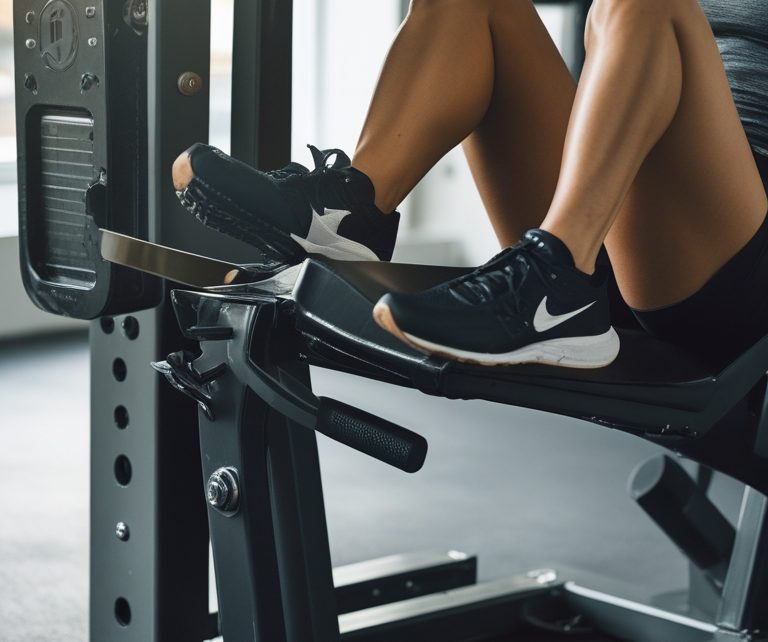
- Height: Sit in the machine and place your feet so that the tops of your shoulders are firmly on the platform. Your heels should be at or *just slightly below* the very top edge. A simple cue: if the platform had a bumper, your heels would be touching it. This ensures your heels stay flat for the entire rep.
- Width: Significantly wider than shoulder-width. A good starting point is so that when you lower the weight, your knees track in line with your ankles (not collapsing inward).
- Foot Angle: Rotate your feet outward, like a “V,” aiming for that 15-30 degree angle. This external rotation aligns with the natural fiber direction of your glute muscles. It allows for a more powerful contraction.
2. The Execution: The Mindful Press.
- Unrack the Weight: Release the safeties and support the weight with your glutes and heels, not your quads.
- The Descent (The Load): Inhale and slowly lower the platform. Your goal is not to bring your knees to your chest. Your goal is to drive your knees toward your armpits. This ensures deep hip flexion. Lower until you feel a profound stretch in your glutes and hamstrings—not in your lower back. If your lower back starts to tuck or round (the “butt wink”), you’ve gone too far. That is your current range-of-motion limit.
- The Ascent (The Squeeze): This is where the magic happens. Exhale and focus everything on pushing the platform away with your heels. Visualize your glutes contracting to straighten your hips. Drive with purpose until your hips are fully extended. At the very top, give your glutes a hard, conscious squeeze for 1-2 seconds. Do not lock out your knees; keep a soft, micro-bend to maintain tension.
This technique is backed by biomechanical research. Experts consistently analyze EMG data showing that movements with deep hip flexion and external rotation, like our high-wide press, produce exceptional glute activation. Explore more of this research-focused analysis here. Furthermore, hypertrophy expert Dr. Brad Schoenfeld’s work reinforces that such strategic modifications are key to targeting specific muscle groups, a principle he’s discussed in depth here.
Chapter 3: The Saboteurs – Common Mistakes That Steal Your Glute Gains
You can have the perfect foot placement, but a single technique error can derail everything. It shifts the load right back to your quads or, worse, into your vulnerable lower back. Be the guardian of your form and avoid these pitfalls:
- Mistake #1: The Low Foot Temptation. This is the #1 glute-gain thief. It feels natural and powerful because it lets your strong quads take over. Resist! Stay high.
- Mistake #2: The Narrow Stance. A shoulder-width stance brings the quads and inner thighs (adductors) back into play. It minimizes the crucial hip abduction that wakes up the gluteus medius.
- Mistake #3: The Half-Rep. Not lowering deep enough is a wasted opportunity. The glutes are most powerfully engaged from a stretched position. A shallow press is a quad-dominant press. Go deep, safely.
- Mistake #4: Heels to Heaven. If your heels lift off the platform, you’ve instantly transferred the work to your calves and the balls of your feet (quad territory). Heels must be glued down.
- Mistake #5: The Round Back. Lowering beyond your hip mobility causes the pelvis to tuck and the spine to round. This disengages the glutes completely and places dangerous shear forces on your lumbar discs. The National Academy of Sports Medicine (NASM) emphasizes the critical importance of maintaining a neutral spine under load. This protects joints and ensures proper muscle recruitment. Learn more about their integrated training principles here. Safety and form are non-negotiable.
Chapter 4: From Activation to Amplification – Pro Techniques to Supercharge Results
Mastered the stance and avoided the errors? Let’s move from good to extraordinary. These advanced tactics will forge an unbreakable mind-muscle connection. They ensure your glutes are firing on all cylinders.
- Technique #1: The Mind-Muscle Connection (MMC): This isn’t woo-woo; it’s science. Before you even move the weight, close your eyes and visualize your glutes swelling and contracting. During the press, use internal cues: “Push with the heels,” “Spread the platform apart with your feet,” “Squeeze the cheeks at the top.” Studies have shown that an internal attentional focus can significantly increase EMG activity in the target muscle. You’re not just moving weight; you’re conducting a symphony of muscle fibers. Browse findings on attentional focus here.
- Technique #2: The Glute Activation Pre-Set. Before your heavy working sets, perform a “wake-up” set. Use a very light weight (or just the sled) for 15-20 slow, perfect reps using your high-wide stance. Focus intensely on the stretch and squeeze. This sends a high-priority neural signal to your glutes, “potentiating” them—priming them to work harder on the following sets.
- Technique #3: Seat Position Tweaks. On leg press machines with an adjustable seat, experiment. Moving the seat farther away from the platform (if the design allows) can create *even more* room for hip flexion. This enables a deeper, more glute-focused stretch without compromising the spine.
- Technique #4: Strategic Supplementation. Use the leg press as your primary glute-building compound movement. Then, after you’ve fatigued them, finish with isolation exercises like hip thrusts, cable kickbacks, or banded lateral walks. This “pre-exhaustion” method ensures your glutes are fully obliterated. It leaves no fiber unstimulated.
Conclusion: Reclaim the Press, Build Your Foundation
The journey to answering where to put feet on leg press for glutes is more than a technique tip—it’s a paradigm shift. It’s about moving with intention, understanding biomechanics, and taking control of your training. By adopting the high, wide, and out stance, executing with a mindful full range of motion, and employing the amplification techniques, you transform a simple machine into a precision glute-forging tool.
Remember, the strongest foundation of any powerful body is a powerful posterior chain. Your glutes are the engine for running, jumping, lifting, and living pain-free. Stop letting them sleep on the leg press. Wake them up, challenge them, and build them with purpose.
Now, get to the gym, adjust those feet, and prepare to feel a burn you’ve been missing for years. The era of the glute-powered press starts now.
Disclaimer: This blog post is for informational purposes based on current exercise science research and expert opinion. Always consult with a certified personal trainer, physical therapist, or medical professional to ensure any exercise is appropriate for your individual anatomy, health status, and fitness level. Proper form is critical to safety and effectiveness.