Weight Rack Safety Tips: Complete Guide to Secure Installation and Accident Prevention
Weight rack safety tips are not just for gym owners. Every home gym needs them too. A falling rack can hurt you, your kids, or wreck your floor. In 2021, gym gear sent more than 400,000 people to the ER. Many of these mishaps came from tipping racks and sloppy storage. The good news? You can stop most accidents with a few smart moves. This guide shows you how to pick the right spot, anchor the rack, and keep it safe for years.
Why Weight Rack Safety Tips Matter
Think a wobble is no big deal? Think again. A 100-pound dumbbell falling from six feet hits with 1,200 pounds of force. That can crack tiles, break toes, or worse. One study found weight-training injuries have jumped 35% in twenty years. Crush injuries make up almost half of these cases. The average ER bill runs $1,389-$3,322, and floor repairs can add another $500-$2,500. source
Safe dumbbell storage keeps your gear—and your wallet—in one piece. A secure rack also saves time. No more hunting for runaway plates or tripping over bars left on the ground.
Weight Rack Safety Tips: Know the Risks
Common Causes of Rack Tip-Overs
- Overloading: Putting 1,000 lbs on a 500-lb rack.
- Bad balance: Stacking every 45-lb plate on the left side.
- No anchors: 73% of tip-overs happen because the rack is not bolted down.
- Loose bolts: Screws back out after months of vibration.
- Uneven floor: A tiny tilt grows into a big wobble.
Red Flags That Scream “Danger!”
Give your rack a gentle shake right now. Does it rock? Do you see bowed beams or cracked welds? Hear squeaks when you load weights? These are signs your dumbbell rack stability is shot. Fix it today, not after someone gets hurt.
Weight Rack Safety Tips: Pick the Perfect Spot
Floor Load-Bearing Check
Concrete garage floors hold 2,500-4,000 lbs per square foot. A wood bedroom floor may only handle 300-500 lbs. If your rack plus weights tops 1,000 lbs, lay down ¾-inch plywood or rubber mats first. source
Space Rules of Thumb
- Leave 3 feet clear on all sides so you can escape if the rack tips.
- Keep an 8-foot ceiling zone for overhead lifts.
- Stay 6 feet away from doors and walking paths.
- Plan 20-30% extra space for future plates and dumbbells.
Floor Protection Under Weight Rack
Best Flooring Choices
- Rubber mats: ⅜-¾ inch thick, last 10-15 years, $2-$5 per sq ft.
- Plywood base: Cheap fix, replace every 3-5 years.
- Virgin rubber gym flooring: Premium feel, 5-year warranty, $8-$15 installed.
Whichever you choose, stagger the seams like bricks and glue them down so corners don’t curl. Let adhesive cure 48 hours before loading weights. source
Weight Rack Installation: Step-by-Step
Tools You Will Need
- Power drill with masonry bits
- ½-inch concrete wedge anchors (minimum 3½-inch long)
- 4-foot level
- Socket wrench set
- Safety glasses and gloves
Anchoring by Floor Type
Concrete: Drill holes ¼ inch deeper than the anchor. Tap anchors in, then torque to 40-50 ft-lbs.
Wood: Find the joists with a stud finder. Drive 5/16-inch x 3-inch lag screws through the rack feet and into the joists. Use big washers so the heads don’t pull through.
Carpet: Lay ¾-inch plywood first, then lag-screw through both carpet and wood subfloor.
If your rack is rated over 1,000 lbs or you’re not comfy with power tools, hire a pro. source
Preventing Tip-Over: Make the Rack Rock-Solid
Add Base Weight
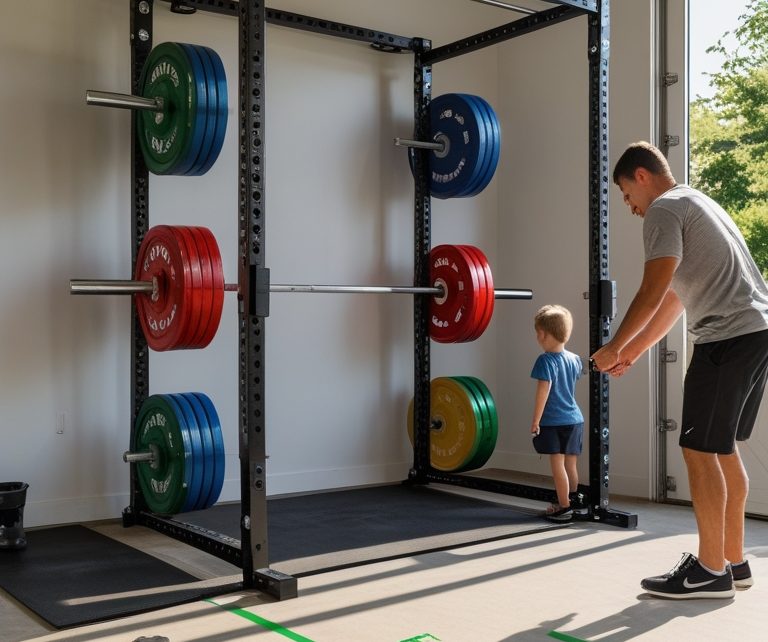
Hang extra 45-lb plates on the lower storage pegs. Aim for at least 25% of the rack’s own weight sitting down low. Think of it as a pyramid: heavy bottom, light top.
Anti-Tip Brackets and Straps
For $15-$30 you can bolt L-shaped brackets to wall studs behind the rack. If wall space is tight, run a 2,000-lb-rated safety strap from the top of the rack to a ceiling joist. These extras buy you precious seconds if a load shifts.
Even Load Distribution
Keep 60% of total weight in the lower third of the rack. Balance left and right within 10%. Never stack plates on the floor in front—someone will trip and bump the rack.
Safe Dumbbell Storage Rules
Where Each Weight Should Live
- Bottom tier: 45-lb plates, 50-100 lb dumbbells, 40-80 lb kettlebells.
- Middle tier: 25-lb and 10-lb plates, 20-50 lb dumbbells.
- Top tier: 5-lb and 2.5-lb plates, 5-20 lb dumbbells, collars, and bands.
Loading and Unloading Etiquette
Always face the rack. Bend your knees, not your back. Keep the weight close to your body and set it down gently. Use two hands for anything over 25 lbs. Leave 20% of each tier empty so plates don’t jam against one another.
Monthly Safety Checklist
Print this list and tape it to your gym door. Check off each item on the first Saturday of every month:
- □ Wiggle test—any bolts loose?
- □ Rust spots—spray with WD-40 and wipe.
- □ Anchor bolts—tighten to spec.
- □ Weight pegs—straight, not bent?
- □ Floor mats—corners still glued?
- □ Document notes in a small notebook.
Every quarter, deep-clean and lubricate moving parts. Every year, have a second pair of eyes inspect welds. If the rack is 10-plus years old or you’ve outgrown its capacity, upgrade before it fails. source
Quick Fixes for a Wobbly Rack
Emergency Stabilizers
If your rack starts to tip mid-workout:
- Clear everyone out of the way.
- Lower weights to the floor, heaviest first.
- Slide shims under the lifted corner.
- Clamp loose joints with C-clamps.
- Restrict the area until you can anchor it properly.
When to Stop Using the Rack Immediately
- You hear metal cracking or popping.
- An anchor bolt pulls free.
- A weld shows a hairline crack.
- The rack sways more than one inch at the top.
Call the Pros
Keep these numbers on your phone:
- Emergency: 911
- Equipment maker support line
- Local licensed handyman
- Your insurance agent
Weight Rack Safety Tips Conclusion
A few dollars spent on anchors, rubber mats, and five minutes of monthly checks can save thousands in hospital bills and busted concrete. Follow the weight rack safety tips above and your home gym will be the safest room in the house. Ready to lock down that rack? Grab your drill, call a buddy to help, and make today “Anchor Day.” Your future self—and your toes—will thank you.